Business is changing fast. Agentic AI and Hyperautomation aren't just tech trends they're changing how companies work, compete, and grow.
This isn't about replacing people. It's about freeing your team from repetitive work so they can focus on what actually matters strategy, creativity, and growth.
What is Agentic AI?
Agentic AI is different from regular AI. Instead of just responding to commands, agentic AI systems work independently and can:
Goal-Oriented Decision Making
Setting and pursuing complex objectives without constant human intervention, adapting strategies based on real-time feedback.
Continuous Learning
Improving performance through reinforcement learning, analyzing outcomes, and refining approaches over time.
Multi-Agent Collaboration
Working alongside other AI agents and humans, coordinating complex workflows across different business functions.
Real-Time Adaptation
Responding dynamically to changing conditions, market shifts, and unexpected challenges with minimal latency.
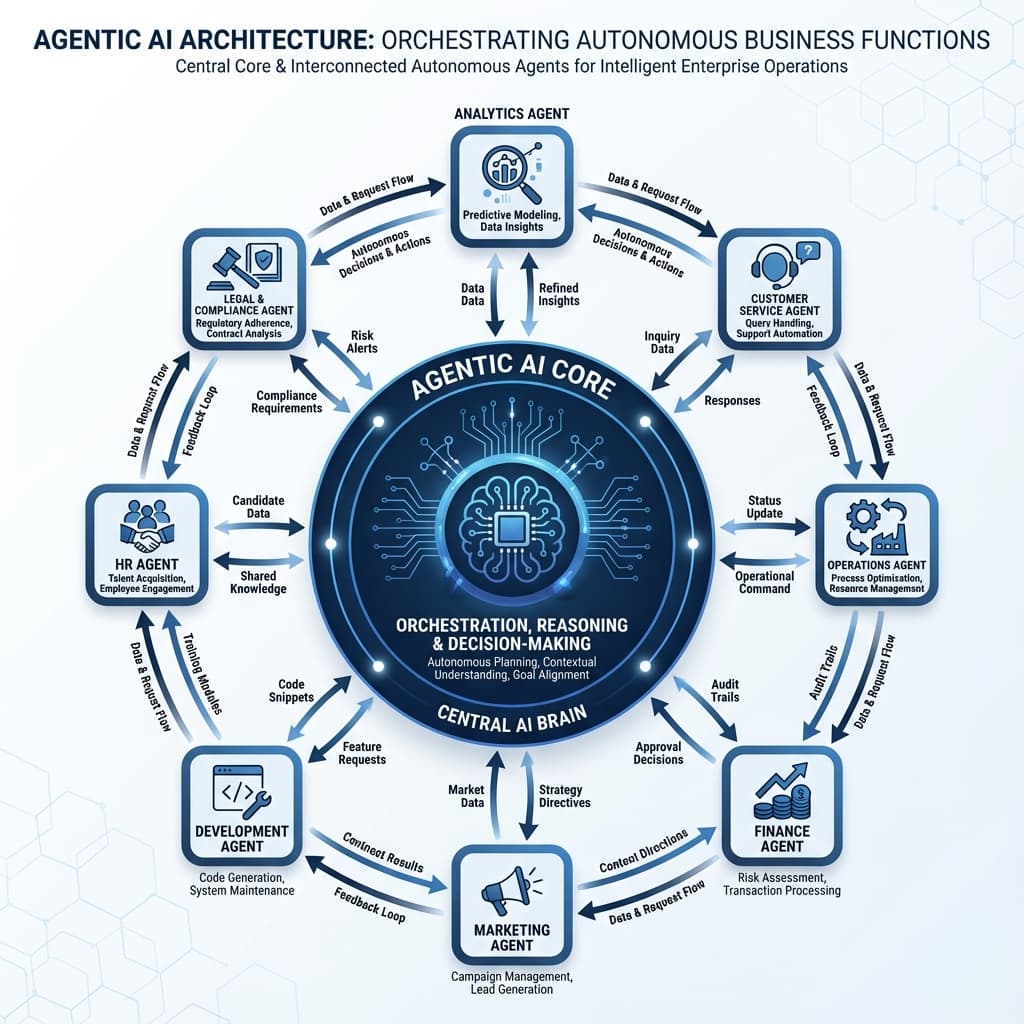
Companies using agentic AI are seeing real results: faster decisions, smoother operations, and teams that can focus on high-impact work instead of routine tasks.
Hyperautomation: Beyond Traditional Automation
Traditional automation handles simple, repetitive tasks. Hyperautomation goes further it combines multiple technologies to automate entire workflows from start to finish.
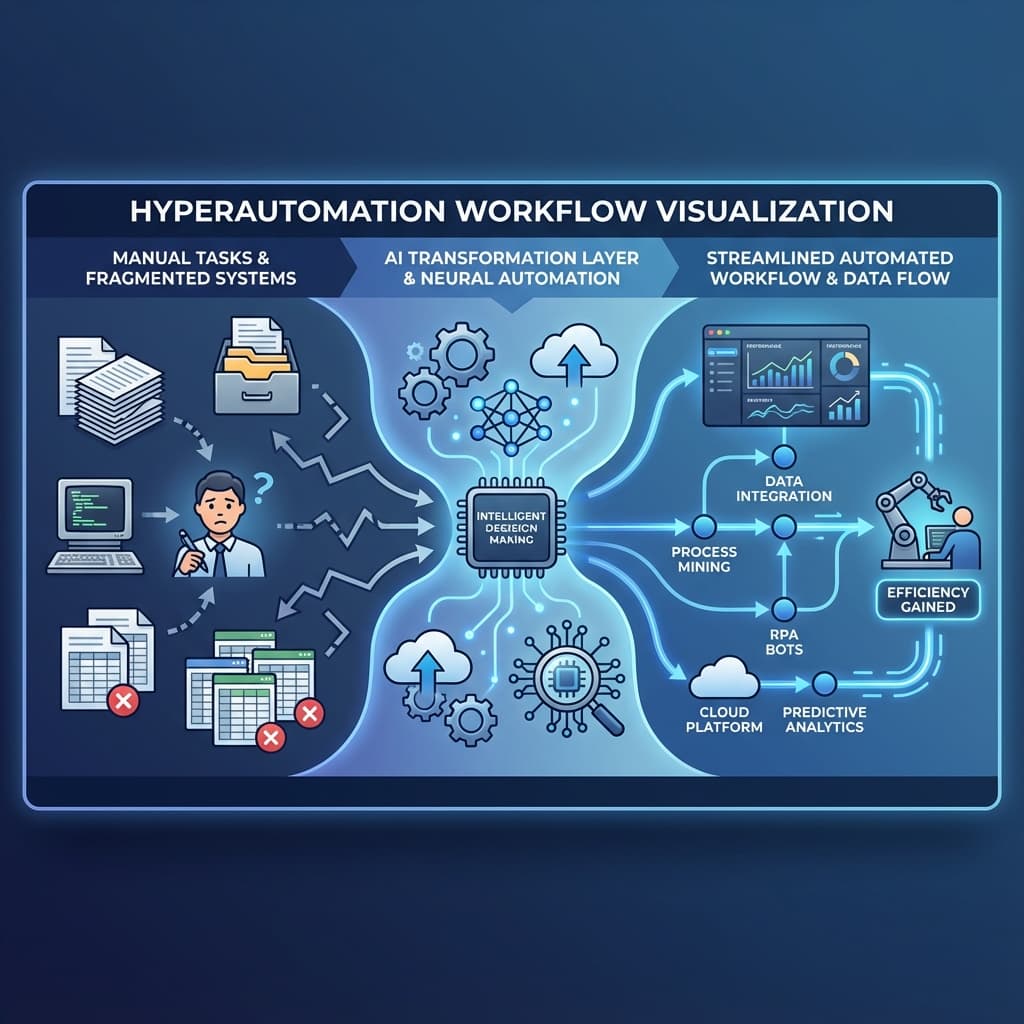
Key Components of Hyperautomation
Robotic Process Automation (RPA)
Software robots that mimic human actions to execute repetitive tasks across applications, from data entry to invoice processing.
Artificial Intelligence & Machine Learning
Intelligent decision-making capabilities that handle unstructured data, predict outcomes, and continuously improve processes.
Process Mining & Analytics
Tools that discover, monitor, and optimize business processes by analyzing event logs and identifying bottlenecks.
Low-Code/No-Code Platforms
Democratizing automation by enabling non-technical users to build and deploy automated workflows without extensive coding knowledge.
Transforming Industries: Real-World Applications

🏥Healthcare
- ✓AI-powered diagnostic assistants analyzing medical imaging
- ✓Automated patient scheduling and follow-up systems
- ✓Drug discovery acceleration through AI agents
💰Finance & Banking
- ✓Real-time fraud detection with autonomous response
- ✓Personalized financial advisory through AI agents
- ✓Automated compliance monitoring and reporting
🏭Manufacturing
- ✓Predictive maintenance reducing downtime by 50%
- ✓Supply chain optimization with AI-driven forecasting
- ✓Quality control automation using computer vision
🛍️Retail & E-commerce
- ✓Hyper-personalized customer experiences at scale
- ✓Inventory management with demand prediction
- ✓24/7 AI customer service agents
How to Implement Agentic AI and Hyperautomation
The best way to implement these technologies? Start small, prove value, then scale. Here's how:
Phase 1: Assessment & Strategy
Identify high-impact processes ripe for automation. Map current workflows, pain points, and opportunities for AI integration.
Timeline: 2-4 weeks | ROI Impact: Foundation for success
Phase 2: Pilot Implementation
Start with a focused use case. Deploy AI agents for specific tasks, measure results, and iterate based on feedback.
Timeline: 6-12 weeks | ROI Impact: 20-30% efficiency gain
Phase 3: Scale & Optimize
Expand successful pilots across departments. Integrate multiple AI agents and automation tools into a cohesive hyperautomation ecosystem.
Timeline: 3-6 months | ROI Impact: 60-80% cost savings
Phase 4: Continuous Innovation
Establish centers of excellence, foster a culture of automation, and continuously explore emerging AI capabilities.
Timeline: Ongoing | ROI Impact: Sustained competitive advantage
The Road Ahead: 2025 and Beyond

What's next? Here are the trends shaping the future of AI and automation:
🌐 Embodied AI
AI agents moving beyond digital realms into physical systems robots, IoT devices, and autonomous vehicles working seamlessly together.
🔒 AI Governance
Robust frameworks ensuring ethical AI deployment, transparency, and accountability in autonomous decision-making systems.
👥 Human-AI Symbiosis
Enhanced collaboration between humans and AI, where each amplifies the other's strengths for unprecedented productivity.
Key Takeaway
AI and automation are changing how work gets done. Companies that adopt these technologies now will have a major advantage. Those that wait? They'll be playing catch-up.
Ready to Transform Your Business?
We help businesses implement AI and automation that actually works. Let's talk about what we can build for you.
Found this article helpful? Share it with your network